



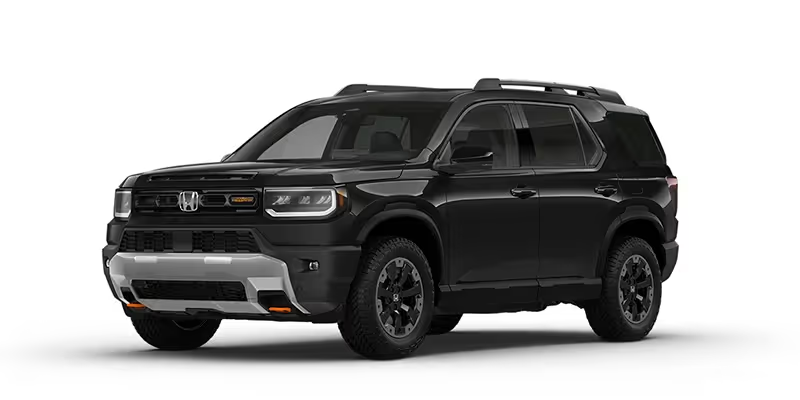
While many Honda Passport owners use their SUVs to haul light weekend toys like jet skis or small teardrop trailers, truly testing a vehicle’s mettle requires pushing it to the edge of its specifications. To see how the Passport TrailSport handles its 5,000-pound maximum towing capacity, I bypassed the light-duty stuff and went straight for a heavy-duty rental: a U-Haul car trailer loaded with a manual Honda Civic Coupe.
The combined weight of the trailer and the car sat at approximately 4,800 pounds. Once you add passengers and a bit of gear into the cabin, the total weight was essentially knocking on the door of the Passport’s legal limit. This real-world evaluation spanned highway stretches and urban navigation to determine if this mid-size SUV is a legitimate “tow rig” or just a weekend warrior.
Towing Duty
Honda has a reputation for thoughtful engineering when it comes to utility, and the Passport benefits from the same architecture found in the Ridgeline pickup. The physical setup for towing is refreshingly logical. The safety chain loops are easy to access without fumbling under the bumper, and the seven-pin connector is positioned near the hitch. While some might prefer the connector to be higher up near the license plate, the lower placement ensures that trailer cables aren’t stretched to their breaking point during tight maneuvers.
The heart of the experience is Honda’s 3.5-liter V6. In an era where manufacturers are swapping cylinders for turbochargers, this naturally aspirated engine remains a standout. With 285 horsepower and 262 lb-ft of torque, the Passport doesn’t feel lethargic. Even with 4,800 pounds dragging behind it, the SUV pulled away from stoplights with surprising urgency.
On the highway, the Passport remained remarkably stable. At a steady 60 mph, road noise was well-controlled, and the vehicle didn’t suffer from the “tail-wagging-the-dog” sensation that often plagues shorter-wheelbase SUVs. Even when I increased the speed to 75 mph to pass slower traffic, the drivetrain stayed in its power band, providing enough grunt to move the massive load without feeling like it was being overstressed.
Braking, however, is where you truly feel the physics of towing at the limit. During a simulated panic stop, the Passport maintained its line and didn’t dive excessively, but the stopping distance was notably extended. It serves as a stark reminder that while the engine can pull the weight, your following distance needs to double when you’re at 95% capacity.
The most interesting takeaway was how the weight affected the Passport’s suspension. In daily driving, the unladen TrailSport can sometimes feel a bit “springy” or bouncy over rhythmic bumps. Adding roughly 500 pounds of tongue weight actually settled the rear end, making the ride feel more planted and dampened. While you lose some of the suspension’s articulation over large potholes, the overall highway composure was actually improved by the load.
Verdict
The Honda Passport TrailSport proves that its 5,000-pound rating isn’t just a marketing figure—it’s a usable reality. It manages heavy loads with a level of confidence that matches some body-on-frame competitors, thanks largely to its stout V6 and smart hitch design. However, just because it *can* tow at the limit doesn’t mean you should do it every day. For those planning frequent long-distance hauls, staying around the 3,500 to 4,000-pound mark would provide a safer buffer for gear and passengers.
In summary, the Passport remains one of the most versatile “right-sized” SUVs on the market. It offers enough mechanical grit to handle a car hauler when necessary, while retaining the road manners of a comfortable family cruiser the rest of the week. If you need to move a heavy trailer across town or across the state, this Honda won’t break a sweat, provided you respect the laws of physics.