


After nearly a decade of success with the first-generation T-Roc, Volkswagen has finally introduced its successor to the European market. This second-generation subcompact crossover arrives with a significant weight of expectation, aiming to build on its predecessor’s popularity while addressing its shortcomings. To evaluate this new iteration, we tested the Euro-spec SUV against its long-standing sibling, the Volkswagen Golf, to see if the high-riding crossover truly offers a superior experience.
Core Specifications and Dimensions
The most immediate change is the vehicle’s physical presence. Volkswagen has notably upsized the T-Roc, adding 138 mm (5.4 inches) to its total length and stretching the wheelbase by 39 mm (1.54 inches). Our evaluation vehicle featured the “Life” trim, equipped with a 1.5-liter mild-hybrid powertrain—a setup that balances efficiency with a necessary power bump for the larger frame.
Exterior Aesthetics and Design Evolution
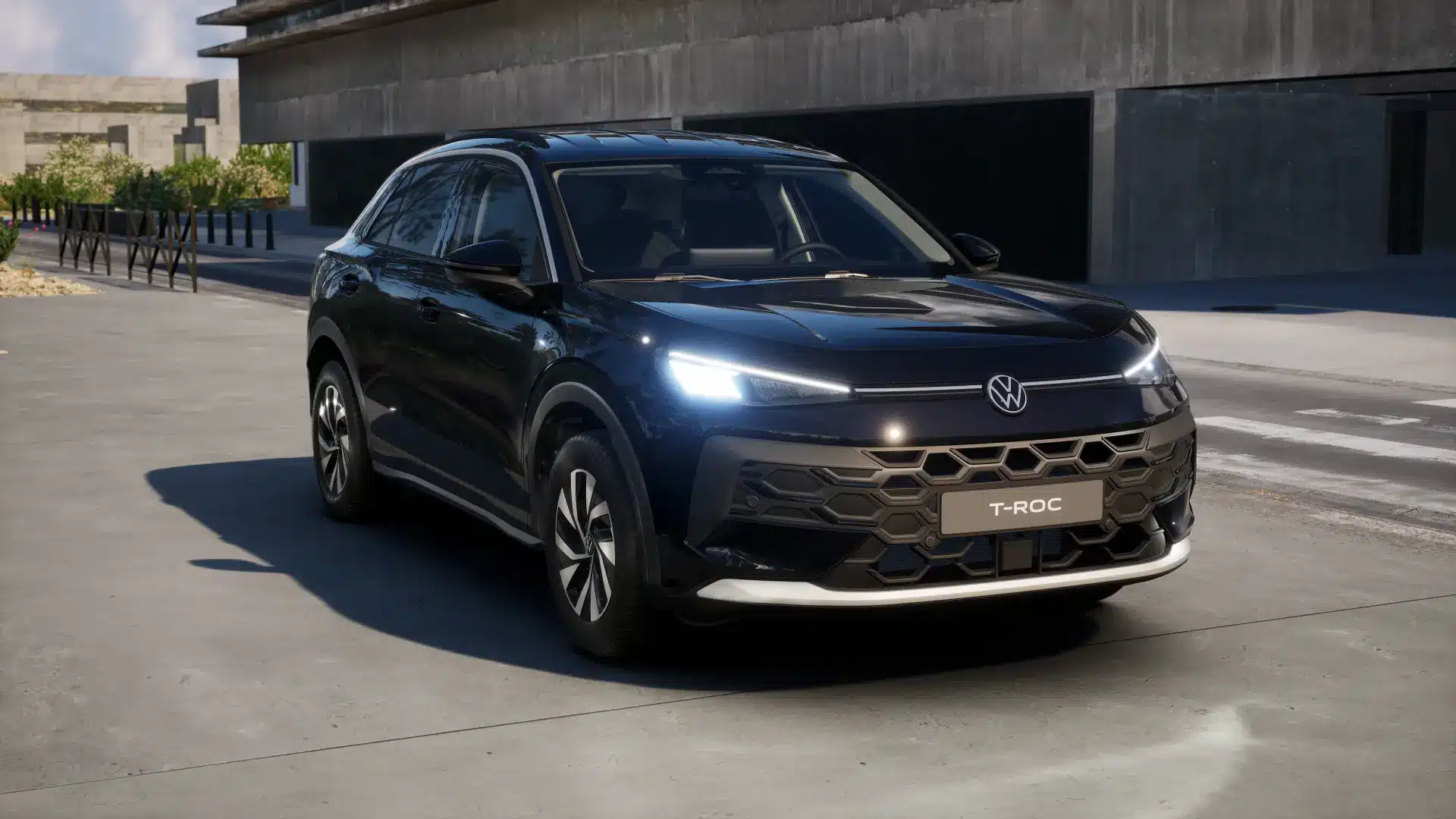
Visually, the new T-Roc adopts a more complex design language. The front fascia features aggressive lighting signatures and a prominent honeycomb plastic texture on the bumper, moving away from the understated elegance of the previous generation. However, signature design cues remain, such as the distinctive chrome-like stripe that flows into the C-pillar and the muscular rear fenders. The rear of the vehicle continues this evolution with a sharp rake to the window, a contemporary full-width light bar, and an illuminated Volkswagen emblem.
While our “Life” trim tester included premium options like the 17-inch multi-spoke alloy wheels, IQ.Matrix LED headlights, and a glowing front grille, it lacked the two-tone contrast roof found on higher trims. Buyers seeking a more aggressive look may still prefer the R-Line, which provides unique bumpers and a lowered ride height.
A More Refined and Tech-Forward Interior
The increase in wheelbase pays immediate dividends inside the cabin, where the T-Roc feels significantly more spacious than its predecessor. One of the biggest complaints regarding the original model was the abundance of hard plastics; Volkswagen has addressed this by introducing soft-touch fabric trim across the dashboard. This, combined with integrated ambient lighting, creates a much more premium atmosphere, though some harder materials persist in the lower door panels and hidden areas.
Digital Interface and Ergonomic Improvements
The cockpit is dominated by an 8-inch digital driver display and a prominent 12.9-inch tablet-style infotainment screen. The software is remarkably fluid with high-definition graphics, though it continues to use touch-sensitive sliders for climate and volume control. To mitigate this, Volkswagen has wisely retained physical, tactile buttons on the steering wheel. Furthermore, a new multifunctional rotary dial on the center console allows for traditional volume adjustment and easy switching between driving modes.
Practicality and Passenger Comfort
The interior layout benefits from the shift to an automatic-only lineup, using an electronic gear selector stalk to free up space for a wireless smartphone charging pad. Rear passengers benefit from the extended wheelbase with improved legroom, and the inclusion of rear air vents is a premium touch rarely seen in this segment. Cargo capacity has also seen a boost, offering 475 liters (16.8 cubic feet) of space—a 30-liter increase over the previous model and nearly 100 liters more than the current Golf.
Driving Dynamics: A Step Toward the Tiguan
On the road, the T-Roc behaves with the predictable composure expected of a Volkswagen. However, the most striking improvement is in refinement. The noise insulation and ride quality have been elevated significantly, making the T-Roc feel more like a junior Tiguan than a budget-oriented T-Cross. Utilizing the updated MQB Evo architecture, the suspension effectively dampens road imperfections while maintaining body control through corners.
Mild-Hybrid Performance and Efficiency
The 148-hp 1.5-liter eTSI engine provides ample power for highway cruising, but its true strength lies in its smoothness. The mild-hybrid system is exceptionally well-integrated, often shutting off the internal combustion engine during coasting or low-load situations. This seamless transition makes the powertrain feel almost like a full hybrid, prioritizing fuel efficiency and cabin serenity over sporty acceleration.
Market Pricing and Contemporary Rivals
In competitive European markets like Greece, the T-Roc range begins with a 114-hp entry-level model priced around €28,590. Our more powerful 148-hp “Life” trim starts at approximately €31,390, while the range-topping R-Line can reach €35,990. These prices place the T-Roc in direct competition with the Hyundai Kona and Toyota C-HR. While the Asian competitors often offer full-hybrid systems at a slightly lower starting price, the T-Roc relies on its interior tech and “big car” feel to justify the premium.
T-Roc vs. Golf: The Internal Competition
Comparing the T-Roc directly with its hatchback cousin, the Golf, reveals a distinct personality split. Despite sharing mechanical components, the Golf remains the superior choice for those who value driving precision; it feels more agile and planted in corners. Visually, the Golf’s recent 2024 update keeps it looking sharp and modern.
Choosing Between the Crossover and the Hatchback
While the Golf offers better handling, the market’s shift toward SUVs is easy to understand when looking at the T-Roc’s higher seating position and superior cargo room. Interestingly, the price gap is narrower than expected. In certain mid-to-high specifications, the T-Roc is actually more affordable or nearly identical in price to a similarly equipped Golf. For many buyers, the added utility of the T-Roc makes it the more logical purchase in the Volkswagen showroom.
Future Performance and Hybrid Variants
The current lineup is just the beginning. Volkswagen has confirmed that the T-Roc will soon receive two self-charging hybrid options to better compete with Toyota and Hyundai. Additionally, performance enthusiasts can look forward to a new T-Roc R, which will feature a 2.0-liter turbocharged engine and all-wheel drive, maintaining the model’s presence in the high-performance crossover niche.
Final Thoughts on the New T-Roc
The second-generation Volkswagen T-Roc is a calculated evolution that delivers exactly what modern consumers prioritize: space, technology, and refinement. By moving to the MQB Evo platform and upgrading the interior materials, Volkswagen has created a vehicle that bridges the gap between subcompact and compact SUVs. While it may lack the sharp handling of the Golf, its combination of everyday practicality and mature road manners makes it a formidable contender in a crowded segment.