









McLaren has long been recognized for producing some of the most communicative steering systems in the supercar world. Now, the brand is set to pair that legendary feedback with a truly mechanical gear-shifting experience. The newly unveiled McL 6GT is a carbon-fiber-bodied V8 supercar that pays homage to Bruce McLaren’s original road-car vision. Most notably, it marks a historic return to the manual transmission, a feature that has been missing from the brand’s lineup for thirty-four years.
The Return of the Manual Transmission to Woking
Introduced during the prestigious Monterey Car Week, the McL 6GT represents the first time a McLaren has featured three pedals since the legendary F1 debuted in 1992. This isn’t merely a retro-fitted gearbox in a standard chassis; it serves as a preview for a new, ultra-exclusive tier within the McLaren family. This branch of the company will prioritize raw driver involvement and emotional connection over sheer lap times, catering to purists who value the tactile nature of driving.
A Performance Recipe Focused on Driver Engagement
The mechanical configuration of the McL 6GT is designed to satisfy the most demanding enthusiasts. At its heart is a V8 internal combustion engine, delivering power exclusively to the rear wheels. Breaking away from the modern trend of simulated manuals or “gated” dual-clutch systems seen elsewhere in the industry, McLaren has opted for an authentic manual gearbox. To ensure the highest level of feedback, the car utilizes hydraulic steering and a lightweight carbon-fiber monocoque, draped in bespoke carbon bodywork. While official performance figures and weight specifications remain under wraps, the focus is clearly on immersion rather than chasing top-speed records.
Design Cues from a Forgotten Legacy
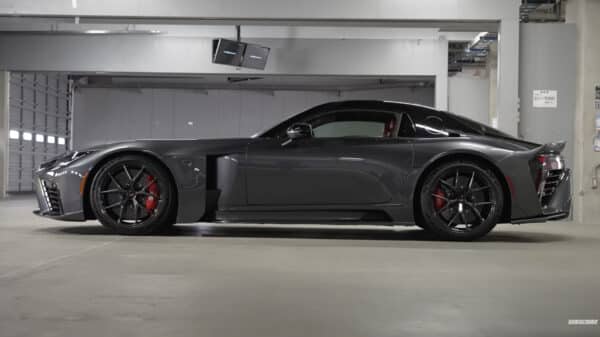
The aesthetic inspiration for this project traces back to the late 1960s and the M6GT—Bruce McLaren’s ambitious plan to turn his dominant Can-Am race cars into road-legal machines. That project was cut short, but the McL 6GT effectively imagines what Bruce might have achieved using today’s state-of-the-art materials and engineering. This lineage explains the car’s distinct silhouette, which deviates significantly from current McLaren models. It features a low-slung, ground-hugging nose and a classic “Kamm” tail. The roofline flows seamlessly into the engine cover, reminiscent of 1960s icons like the ATS 2500 GT or the Bizzarrini 5300 GT Strada.
Exquisite Interior Detail and Craftsmanship
The cabin of the McL 6GT is filled with nods to the brand’s history and its founder. Bruce McLaren’s signature is etched into the engine bay, while the fuel filler cap bears the original “Speedy Kiwi” emblem. Even the gear lever features a three-dimensional Kiwi motif. Rather than copying the traditional metal gates used by other historic brands, McLaren developed a unique, modern shifter design that feels authentic to its own heritage. The interior environment is further enhanced by machined aluminum switchgear, exposed carbon fiber elements, and quilted upholstery inspired by the original M6GT prototype.
The Path to Production and Future Outlook
While currently labeled as a concept, the McL 6GT is a clear statement of intent for the brand. McLaren has confirmed that a production version is slated for 2028. This model will occupy a space “beyond the core portfolio,” offering a rare combination of modern performance and analog control. By committing to a manual gearbox and hydraulic steering in a world of increasing electrification and digital interfaces, McLaren is positioning itself as a champion of the pure driving experience for the next generation of collectors.
Final Thoughts on the McL 6GT
The McL 6GT is more than just a tribute to the past; it is a strategic move by McLaren to capture the growing market for high-engagement, analog supercars. By revisiting Bruce McLaren’s unfinished M6GT project, the company has found a way to blend historical significance with cutting-edge carbon-fiber technology. For enthusiasts who have spent decades waiting for a true successor to the F1’s driver-centric philosophy, the 2028 production date cannot come soon enough. This car signals a refreshing shift in priority from digital perfection to mechanical soul.