








Strengths: Assertive design language, formidable power delivery, high driver engagement, and a compelling synthetic soundtrack.
Weaknesses: Significant price premium, subpar energy efficiency, and a heavy curb weight.
The evolution of Genesis as a luxury powerhouse is accelerating. While the brand initially signaled a pivot toward a purely electric future, it has recently adjusted its strategy to include hybrid and range-extender powertrains. Simultaneously, the late 2024 launch of the Magma sub-brand marks a bold entry into the high-performance arena. Magma serves as the Genesis equivalent to BMW’s M division or Hyundai’s N department, focusing on vehicles that harmonize extreme performance with the sophisticated refinement expected by luxury buyers.
This performance initiative isn’t limited to public roads. Magma is already asserting its presence on the track, having recently debuted the GMR-001 hypercar at the 24 Hours of Le Mans, with further interests in GT3-class racing. The first global production vehicle to carry this torch is the GV60 Magma, a crossover that offers a definitive look into the brand’s performance-oriented future.
Technical Specifications and Performance Metrics: 2027 Genesis GV60 Magma
| Vehicle Model | 2027 Genesis GV60 Magma |
| Starting Price | US$69,950 (USA) / AU$130,000 (Australia) |
| Exterior Dimensions | 182.4″ L x 76.3″ W x 61.4″ H |
| Wheelbase | 114.1 inches |
| Curb Weight | 5,004 lbs (2,270 kg) |
| Powertrain Configuration | 84 kWh battery | Dual electric motors |
| Total System Output | 641 hp (478 kW) / 582 lb-ft (790 Nm) |
| 0-62 mph (0-100 km/h) | 3.4 seconds |
| Transmission | Single-speed reduction gear |
| Real-World Efficiency | 26.5 – 27 kWh/100 km |
| Market Status | Available now |
In the Australian market, the GV60 Magma arrives alongside the entry-level rear-wheel-drive GV60 Advanced. Launching roughly two years after its platform-mate, the Hyundai Ioniq 5 N, the Magma commands a significant price premium of approximately AU$20,000 over its Hyundai cousin. In the United States, the pricing is more competitive, starting at $69,950. This places it about $10,000 above the Ioniq 5 N, reflecting its more premium positioning and enhanced luxury appointments.
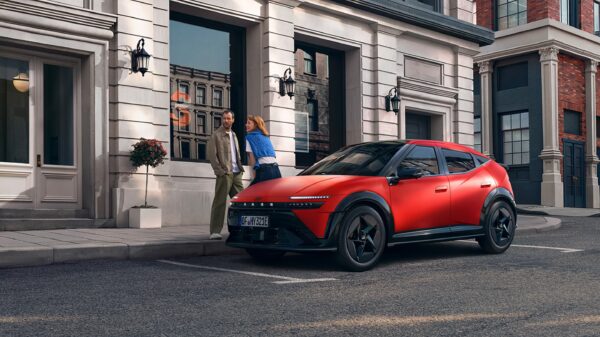
The GV60 Magma utilizes a familiar high-output recipe, employing dual electric motors to generate a peak 641 horsepower. However, Magma distinguishes itself from the “boy racer” aesthetic of the Hyundai N products. The philosophy here is “sophisticated performance”—delivering thrills without compromising the serene cabin environment. Visually, the Magma variant is broader and lower than the standard GV60, featuring aggressive bumper designs, lightweight 21-inch forged alloy wheels, and a prominent rear wing that aids aerodynamics.
A Fusion of Luxury and Performance in the Cockpit
The GV60 Magma debuts alongside a facelift for the entire GV60 range, inheriting a sleek 27-inch integrated OLED display that combines the instrument cluster and infotainment system. Genesis has gone to great lengths to ensure the Magma’s interior feels distinct. The cabin is outfitted with 10-way adjustable sports bucket seats, accented by striking orange contrast stitching and piping that mirrors the Magma brand colors.
The driver interface includes a specialized steering wheel featuring a dedicated Magma mode dial and a tactile “Boost” button. The use of premium materials like brushed black aluminum and Chamude—a suede-like textile—on the seats, door cards, and headliner elevates the atmosphere. Unlike the standard model’s available white interior, the Magma focuses on a dark, performance-centric theme that feels both purposeful and characterful.
Tailored Performance Tech and Drive Modes
Inside the infotainment system, a dedicated Magma interface provides performance telemetry and adjustment settings. While it shares DNA with the Ioniq 5 N, the GV60 Magma offers a more streamlined approach to customizability, favoring a refined experience over granular track settings. Drivers can choose between Range, Comfort, and Sport modes, or engage a bespoke “My Drive Mode.”
Key performance features include a “GT” mode that synchronizes the powertrain and steering for maximum response, and an active sound design system that can be toggled to suit the driver’s preference. For more specialized maneuvers, the vehicle includes a Drift Mode and a Sprint Mode for maximum attack. Battery conditioning settings are also available to optimize thermal management for drag racing or extended track sessions. This balance ensures the car appeals to a more “distinguished” enthusiast who seeks excitement without the harsh edges of a dedicated track toy.
Behind the Wheel: Balancing Ferocity with Refinement
The GV60 Magma is a formidable performer that hides its 5,000-pound mass with surprising agility. Equipped with bespoke Pirelli P Zero Elect tires, the crossover offers tenacious lateral grip. The shorter wheelbase compared to the Ioniq 5 N makes the Magma feel more rotating and compact through tight corners. While the ride quality is firm due to the performance-tuned, stroke-sensing electronic suspension, it remains compliant enough for daily commuting.
One of the standout features is the simulated eight-speed gearshift system. Much like the setup found in the latest high-performance Hyundais, these virtual shifts provide a physical “kick” through the chassis, successfully replicating the mechanical engagement of a combustion engine. The synthetic sound profile has been tuned to mimic a high-revving six-cylinder engine rather than a four-cylinder, revving virtually to 9,000 rpm. This audio can be projected through external speakers or silenced entirely for a traditional EV experience.
Acceleration is predictably violent. The 3.4-second sprint to 62 mph is easily repeatable, even in less-than-ideal conditions. The “Boost” button provides an additional 40 hp and 37 lb-ft of torque for 15-second intervals, providing a noticeable surge for overtaking. To bring all that speed to a halt, Genesis equipped the Magma with massive 400 mm front discs and four-piston calipers, working in concert with a powerful regenerative braking system to achieve impressive stopping distances.
Real-World Efficiency and Charging Infrastructure
The dual-motor setup and aerodynamic enhancements come at a cost to efficiency. While Genesis claims a range of 425 km (264 miles) based on a 21.5 kWh/100 km rating, real-world testing suggests a much heavier consumption of approximately 27 kWh/100 km. In spirited driving scenarios, this can drop the effective range to just over 300 km (186 miles), which may be a limitation for long-distance enthusiasts.
However, the 800-volt E-GMP architecture remains a major asset. The GV60 Magma supports DC fast charging at speeds up to 265 kW, allowing the 84 kWh battery to replenish from 10% to 80% in just 18 minutes. For daily use, the regenerative braking system is highly adjustable via steering wheel paddles, offering everything from coasting to full i-Pedal one-pedal driving, with an intelligent “Auto” mode that adapts to traffic flow.
Final Perspective: The Genesis Magma Brand Trajectory
Genesis faces the significant challenge of establishing a performance legacy in a market dominated by storied European marques. While the Magma brand is in its infancy, the GV60 Magma proves that the company understands the nuances of the high-performance luxury segment. It successfully bridges the gap between the raw, visceral nature of the Hyundai N models and the polished sophistication of a luxury grand tourer. While it may not be a high-volume product, it serves as an excellent halo car that demonstrates Genesis’s ability to inject soul and engagement into the electric era. The future of the Magma sub-brand appears both bright and exceedingly fast.