

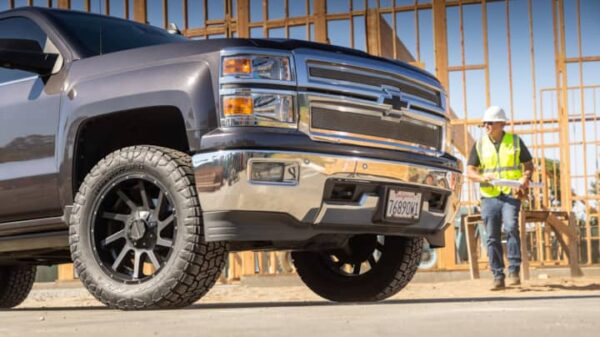


Some pickups are designed to attract attention, but the 2026 Chevrolet Silverado ZR2 is built to dominate the space around it. Stretching 232.8 inches in length and measuring over 81 inches wide, this truck is an imposing presence on any road. With its towering hood line, massive front grille, 33-inch mud-terrain tires, and functional red recovery hooks, the ZR2 doesn’t just suggest off-road capability—it broadcasts it.
Under the hood, the 6.2-liter V8 engine delivers a robust 420 horsepower and 460 lb-ft of torque. This power, combined with front and rear electronic lockers, a two-speed transfer case, and the celebrated Multimatic DSSV dampers, allows the Silverado to conquer challenging terrain with ease. However, this hardware comes with trade-offs. In real-world testing over 210 miles, the truck averaged just 11.9 mpg, making its $76,290 price tag only the beginning of the investment required to own one.
Core Specifications
The fundamental question for potential buyers is not whether the ZR2 is capable—it clearly is. Instead, it is a matter of utility: will the owner actually find enough opportunities to utilize its specialized off-road engineering to justify the significant compromises in fuel economy, size, and urban maneuverability?
The Visual Identity: Rugged but Understated
The Silverado ZR2 follows a design philosophy that is unapologetically “old-school truck.” The proportions are massive, featuring a high beltline and a front fascia that feels large enough to dwarf a subcompact car. To distinguish the ZR2 from the rest of the lineup, Chevrolet added black fender flares, darkened wheels, and a lifted suspension. While the red accents on the “FlowTie” emblem and tow hooks provide a splash of color, the overall look is more reserved than its primary rivals.
Compared to the Ford F-150 Raptor’s aggressive wide-body stance or the Ram RHO’s high-drama styling, the Silverado is relatively anonymous. From a side profile, it looks like a tastefully modified standard truck. For some, this lack of “visual noise” is a benefit; it offers high-end performance without the “Baja racer” aesthetic. However, at this price point, some enthusiasts might find it lacks the unique personality found in a Ram Rebel or a Raptor.
Ultimately, the ZR2 isn’t trying to be a high-speed desert flyer in the mold of the TRX. It feels more like a sophisticated alternative to the F-150 Tremor—a truck designed for technical trails and heavy-duty work rather than jumping sand dunes.
Inside the Silverado ZR2: A Practical and Tech-Forward Interior
The cabin serves as the truck’s strongest selling point. Chevrolet has designed a cockpit that balances modern technology with rugged utility. The centerpiece is a large, high-resolution infotainment system that is remarkably responsive. The digital instrument cluster offers sharp graphics and intuitive navigation through various off-road telemetry and vehicle settings.
Crucially, Chevrolet has resisted the trend of moving every function into a touchscreen. The ZR2 retains physical knobs and buttons for the climate control, audio volume, and critical truck functions. There is even a dedicated physical switch for the head-up display. This layout is a major advantage when navigating a nearly 20-foot-long vehicle through tight spaces or rocky trails where driver focus is paramount.
While most materials feel premium and durable, there are occasional reminders of the truck’s utilitarian roots. Some plastics on the lower dash and steering wheel feel a bit budget-conscious for a $76,000 vehicle. However, the overall construction feels built to last, designed to withstand the wear and tear of muddy boots and outdoor gear rather than mimicking the delicate luxury of a high-end sedan. One notable quirk is the column-mounted gear shifter; it feels somewhat dated compared to the sleek, modern dashboard, though it does free up space on the center console.
Storage and passenger space are standout features. The “hidden” dual glove box is a clever touch, and the center console is deep enough for large items. Interestingly, the Silverado 1500 offers rear legroom that rivals or exceeds its Heavy Duty siblings. Rear passengers also enjoy amenities like heated outboard seats and integrated storage compartments built directly into the seatbacks.
Performance and Handling: Managing Massive Proportions
Driving the Silverado ZR2 is an exercise in managing scale. From the driver’s seat, the vast hood seems to disappear into the horizon, and the wide mirrors require constant attention in traffic. It is a vehicle that demands deliberate inputs; it does not “shrink” around the driver the way some modern SUVs do. In urban environments, parking garages and narrow streets become legitimate obstacles.
The V8 engine provides ample power, but the ZR2’s sheer mass prevents it from feeling exceptionally quick. The 10-speed automatic transmission is smooth and keeps the engine in its powerband, but the truck’s weight is always felt. The steering is tuned with a heavier weight, which provides stability on the highway, and the braking is predictable and linear.
The real star of the driving experience is the Multimatic DSSV damper system. These spool-valve shocks are sophisticated pieces of engineering that provide exceptional body control. On the highway, they soak up road imperfections with a level of composure that is rare for a truck on 33-inch mud tires. When the pavement ends, the ZR2 truly shines. It handles ruts, rocks, and mud with a level of confidence that would stop most standard pickups. It may not have the playful agility of a Raptor, but its technical competence on rough terrain is undeniable.
Real-World Efficiency and Ownership Costs
The financial reality of the ZR2 becomes clear at the fuel pump. Our testing yielded 11.9 mpg in a mix of city and light off-road driving. While this is a worst-case scenario, the official EPA ratings (14 city / 17 highway / 15 combined) aren’t much higher. According to official estimates, ZR2 owners can expect to spend significantly more on fuel over five years than the average new vehicle owner.
Potential buyers must factor in more than just the monthly payment. The cost of replacing large off-road tires, insurance premiums for a high-value truck, and general maintenance for a specialized 4×4 system add to the total cost of ownership. The ZR2 is a vehicle for those who truly need its specific set of skills, as the daily operating costs are high for someone using it as a simple commuter.
Market Rivals: Finding the ZR2’s True Peers
While it is tempting to compare the ZR2 to the F-150 Raptor or the Ram TRX, those trucks occupy a different niche focused on high-speed desert performance and “look-at-me” styling. The Silverado ZR2 is better suited as a competitor to the Ram Rebel or the F-150 Tremor. It is an off-road package for the buyer who wants serious hardware and a V8 engine without the flamboyant graphics and wide-body kits.
The ZR2’s primary advantage over its direct rivals is its ride quality. The DSSV dampers offer a level of refinement on the street that few other lifted trucks can match. It bridges the gap between a standard work truck and a dedicated off-road racer, providing a high level of capability in a package that remains usable for long-distance road trips.
Final Assessment: Specialized Capability at a Premium
The 2026 Chevrolet Silverado ZR2 is a highly specialized tool. It is expensive to operate, difficult to park in the city, and lacks the raw speed of the industry’s most famous “super-trucks.” However, for a specific demographic—such as those living in rural areas, mountain towns, or anyone who frequently encounters challenging terrain—the ZR2 is an exceptional choice. It offers genuine off-road mastery, a spacious and tech-forward interior, and the best suspension technology in its class. For the person who needs to navigate mud and rocks as part of their daily life, the ZR2 is a sophisticated, highly capable partner. For the urban driver, however, it remains a massive and expensive piece of overkill.